AL-ANDALOUS
In his film “Destiny”, the Egyptian director Youssef Chahine shows Andalusia in the 12th century . It greatly helps us to imagine the atmosphere, the customs and the intellectual and religious aspects of this region, around the cities of Cordoba and Seville, which was under the domination of the Almoravid dynasty . It was a time when interest in science, medicine, astronomy, pharmacopeias grew and universities, libraries, botanical gardens, started to expand.
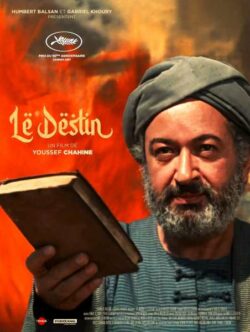
The plot of the film unfolds around an emblematic character of that period, Averroes (Latin name) or Ibn Rochd (Arabic name). Numerous clashes between religious fanatics and scholars, more open to the spread of ideas, are raging. The life and work of Averroes will focus on the fight between tolerance and fundamentalism. “Ideas have wings. No one can stop their flight.” This quote concludes the film to signify that intellectual freedom and knowledge cannot be suppressed, even when faced with censorship or violence. Averroès’ writings will finally escape the autodafe ordered by the Caliph.

Debates. Scene of the film “Destiny”
In Morocco, Averroes or Ibn Rochd gives his name to avenues, clinics, schools, an international university… but who really knows this erudite, learned, and philosophical character. It must be said that one must go back far in time!

Clinic Averroès Marrakech
THE MAN
Averroes, whose real name is Abou Al Walid Muhammad Ibn Rochd, was born in 1126 in Cordoba, then under the domination of the Almoravid Empire, a Berber dynasty originating from Morocco.
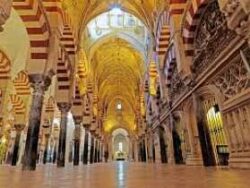
Cordoba
His family, the Banū Rushd, were renowned for their erudition and commitment to religious and judicial affairs. His grandfather, also named Ibn Rushd, was the supreme Cadi (judge) of Cordoba and the Imam of the Great Mosque, highlighting the deep roots of the family in the malekite legal tradition, predominant in North Africa.
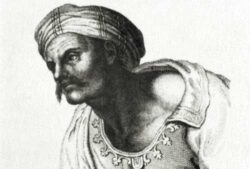
Averroes/Ibn Rochd
From an early age, Averroes/Ibn Rochd received a rigorous education in theology, Islamic law, medicine and philosophy. He studied and benefited from the flourishing intellectual environment of Al-Andalus, closely linked to the Moroccan centres of knowledge.
In 1153, Averroes/Ibn Rochd went to Marrakesh, capital of the Almohad Caliphate, to make astronomical observations and contribute to the foundation of new educational institutions.
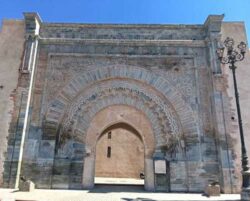
Bab Agnaou. Almohad period Marrakech.
He met Ibn Tufayl, a philosopher and court physician, who introduced him to the Caliph Abū Yaʿ qūb Yūsuf. The Caliph, impressed by Ibn Rochd’s erudition, and following the advice of Ibn Tufayl, entrusted him with the task of commenting on the works of Aristotle, marking the beginning of his famous philosophical exegeses.
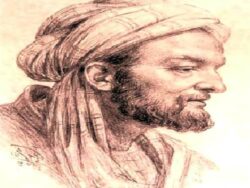
Ibn Tufayl
Averroes/Ibn Rochd tells: “One day, Ibn Tufayl told me that the Caliph complained about the complexity of Aristotle’s expression and the difficulty in understanding it. It would be necessary to find a good interpreter! If you have the energy for such an undertaking, he tells me, go ahead. I am confident because you are sincere, brilliant, and dedicated to what you do.” He thus became his protector. Averroes held various positions. He was a judge, Cadi, in Seville and Cordoba.
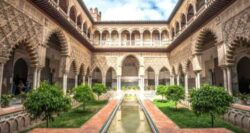
Seville Alcazar
He also practiced as a doctor, even becoming the personal physician of the Caliph, after Ibn Tufayl. But it is his activity as a thinker and philosopher that makes him unique. He writes some personal treatises and spends most of his life commenting on and transmitting the work of Aristotle. His work is challenged and discredited by fierce opponents. He is banned in 1895 and exiled to Lucena, in the province of Cordoba.
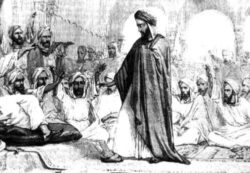
Averroes banished by the Caliph
He then goes to Marrakech where he dies in 1198. He is buried there and then his remains, it is said, will be transferred to Cordoba.
HIS WORK
He is the author of a treatise on medicine, Le Colliget, which will long serve as a reference in anatomy and pharmacology. He is also sometimes called The Commentator, in connection with his work of study and analysis of the work of the famous Aristotle.
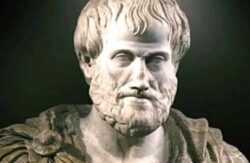
Bust of Aristotle
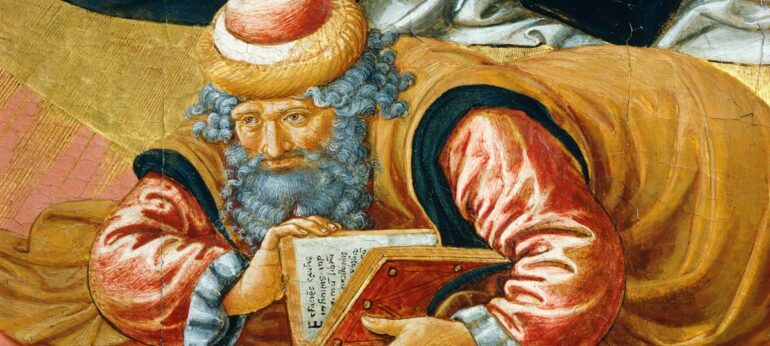
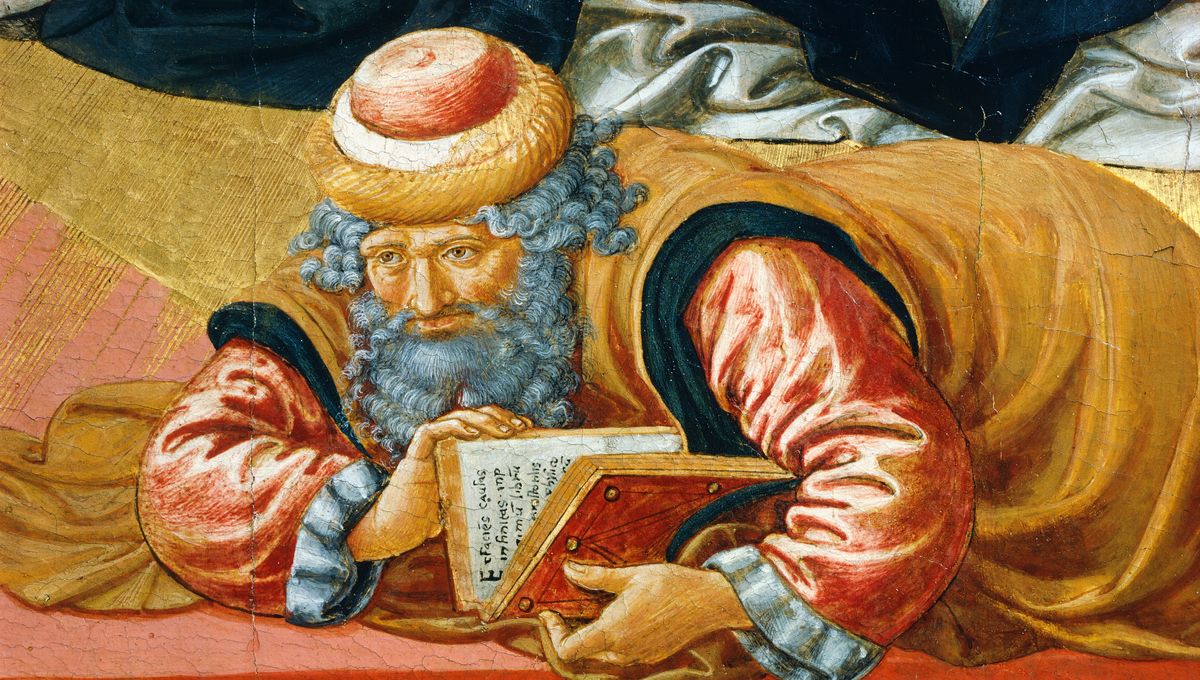
Some consider him the precursor of the Enlightenment. He also largely inspired Saint Thomas Aquinas who, however, will fight him, considering him as a corruptor, heretical, destroyer of the faith. Many paintings illustrate the triumph of the Christian Saint Thomas Aquinas over the Muslim Arab Averroes.
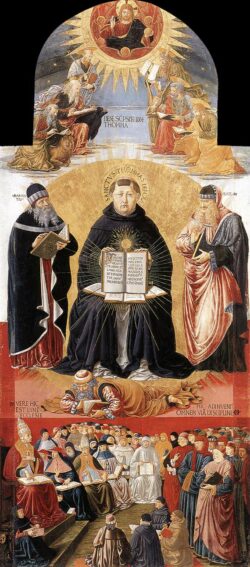
Gozzoli Triumph of St Thomas Aquinas. Benozzo Gozzoli around 1470.
It is never easy to summarize the thought of a philosopher. That of Averroes is particularly complex and I will not venture here to try to explore it. I will just give some clues. Averroes first allowed the circulation of Greek philosophy in the Islamic world and within medieval Europe.
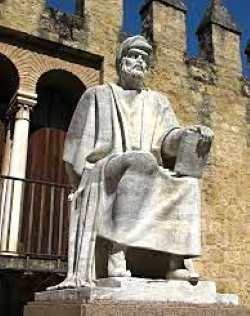
Averroes. Statue in Cordoba.
His ideas argue that reason, philosophy, and faith are not incompatible. Quite the contrary, they complement each other. The concepts that interest him and nourish his reflection are “Thought” and the way it proceeds in man, the definitions of the human soul and body, the compatibility of religious dogmas and philosophy, Truth, science…even the place of women in the society.
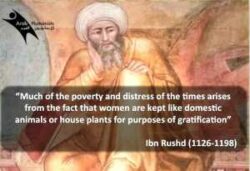
HIS HERITAGE
The links with René Descartes (1596-1650) are woven several centuries apart, even though the french philosopher will also be very critical and theorizes their disagreements.
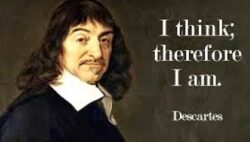
Averroes does not believe in the immortality of the soul nor in the creation of the universe. He can be considered a rationalist. Before being rejected by the Church, Averroes’ theses were long accepted in the first Western universities, Paris, Oxford, Padua. Another major philosopher, considered the father of the Enlightenment, Spinoza (1632-1677) is in the line of Averroes.
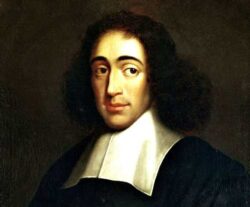
Spinoza
In Morocco, his heritage is considered a symbol of the intellectual wealth of the country, crossroads of knowledge and cultures. Averroes/Ibn Rochd clearly contributed to universal civilization and the country takes a lot of legitimate pride in it.
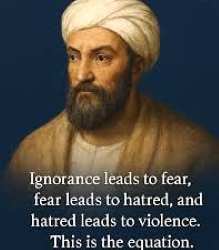
To go further
. Averroes : His life, work and Influence by Majid Fakhry. A comprehensive look at the philosopher’s life and influence, according to Simon and Schuster.
. Averroes and his philosophy by Olivier Leaman. An analysis of his philosophical approach.
. Interpreting Averroes (various authors). A collection of essays on his thought, published by Cambridge University Press.